 Neuroclimate
Impacts of Climate Change
A warming planet brings more frequent and intense heat waves, wildfires, floods, storms and droughts. These events affect our health directly, and indirectly through food, water, housing and livelihoods.
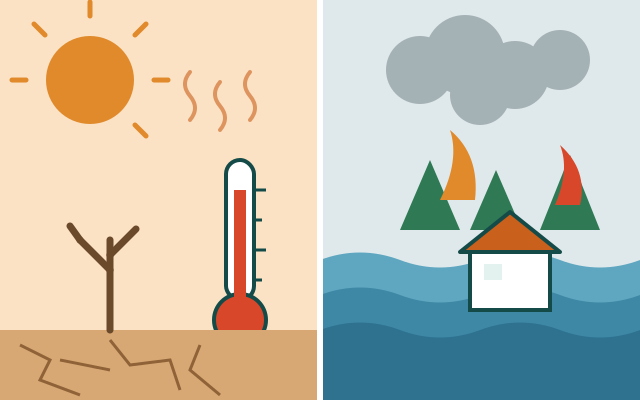
Key climate hazards
Lecture one articleArticle 3: Environmental Risks to the Central Nervous System: The Effects of Air Pollution on Humans
Air pollution, especially fine particulate matter of size 2.5 micrometers or less, commonly referred to as PM2.5, presents a very serious threat to human well-being in ways that go beyond just the respiratory system. Whereas larger air particles are usually filtered out by the body’s defense mechanisms in the form of the cilia in the nose, the PM2.5 particles pass through such defenses easily. As a result, the particulates penetrate deeply into the lungs and alveoli where gas exchange takes place. Given that the walls of the alveoli are extremely thin, the ultrafine particles enter the pulmonary capillaries directly into the bloodstream.
After penetrating into the circulatory system, the air pollutants cause significant harm at the cellular and neurological levels, due to their effect on important protection mechanisms. Normally, the central nervous system (CNS) is protected from the toxins, pathogens, and pollution present in the bloodstream due to its protection by the blood-brain barrier (BBB). This barrier consists of a layer of endothelial cells in the blood vessels of the brain, which form an impermeable membrane. Nonetheless, the tiny PM2.5 particles have the capacity to destroy or even pass through the barrier.
Foreign particulate matter causes localized neuroinflammation and severe oxidative stress inside the brain, leading to the activation of microglial cells that serve as immune defense cells in the central nervous system. Microglial cell activation causes the release of pro-inflammatory cytokines, such as TNF-alpha and IL-6, which damage neurons and synapses inside the brain’s critical regions, such as the prefrontal cortex and the hippocampus. This leads to physiological symptoms such as brain fog, executive function impairment, memory impairment, and severe disruption of sleep cycles. Prolonged exposure to fine particulate matter increases the risk of ischemic stroke, cognitive decline, development of Alzheimer’s and vascular dementias, and symptom exacerbations in patients suffering from neuroinflammatory diseases, such as Multiple Sclerosis.
Article 6: Cascading Global Threats: The Impact of Climate Change on Food and Water Supply
The phenomenon of climate change is a key threat multiplier in terms of global and regional human security since it creates an instability within the natural environment necessary for the provision of water and food resources. Changes in the processes of the atmosphere and temperature increase lead to disruption of the hydrological cycle and occurrence of long-term droughts and melting of alpine glaciers. On the territories of farming, drought and heat lead to aridization of the top layer of soil, resulting in its degradation and decline of productivity of crops along with water shortage. Such water shortages hinder the possibility of irrigation and decrease the production of food resources.
At the same time, climate-induced warming of the atmosphere increases the severity of extreme weather conditions, such as heavy hail, flash floods, and wildfires during off-seasons, that physically damage mature crops, render arable land contaminated, and disrupt essential modes of transport. With extreme weather events destroying harvests and hindering distribution channels, food shortages arise quickly and raise the price of food to levels at which poor families cannot afford basic meals. Moreover, increased heat stress changes the balance of micro-organisms in soils, encouraging the spread of pests and diseases among crops.
Access to safe, drinkable water is also limited by the increasing climate risks. Increased rainfall and quick runoff carry chemicals used for fertilizer applications, various industrial toxins, raw sewage, and hazardous waste from agriculture into primary sources of water – rivers and lakes. During wildfire seasons, heavy sedimentation and ash runoff contaminate the water systems of cities with heavy metals and fine particulates, which overload the capacity of water treatment systems and lead to extended “boil water” orders. Moreover, in coastal regions, increased sea levels bring salty water into freshwater sources and make them unfit for consumption.
Sources & further reading
- IPCC (2022/2023). Sixth Assessment Report: Impacts, Adaptation and Vulnerability. ipcc.ch
- World Health Organization. Climate change and health fact sheet. who.int
- The Lancet Countdown on Health and Climate Change (annual reports). lancetcountdown.org
References: Article 3
- Environmental Protection Agency. (2023). Basics and health impacts of particulate matter (PM2.5). U.S. Environmental Protection Agency. Retrieved from: https://www.epa.gov/pm-pollution/health-and-environmental-effects-particulate-matter-pm
- Ikiz, B., & Neuro Climate Working Group. (2024). State-of-science report on climate change and brain health: Neurological effects of air pollutants and heat exposure. Neuro Climate Working Group.
- World Health Organization. (2021). WHO Global Air Quality Guidelines: Particulate Matter (PM2.5 & PM10), Ozone, Nitrogen Dioxide, Sulfur Dioxide & Carbon Monoxide. World Health Organization. https://www.who.int/publications/i/item/9789240034228
References: Article 6
- IPCC. (2023). Climate change 2023: Synthesis report. Contribution of Working Groups I, II and III to the Sixth Assessment Report of the Intergovernmental Panel on Climate Change. IPCC. https://www.ipcc.ch/report/ar6/syr/
- United Nations Environment Programme. (2022). Global environmental outlook: Climate change, food security, and water vulnerability. UNEP. Retrieved from https://www.unep.org/resources/global-environment-outlook
- WHO. (2023). The impact of climate change on water quality and health equity: A global assessment. World Health Organization. https://www.who.int/news-room/fact-sheets/detail/climate-change-and-health