 Neuroclimate
Climate Change & Brain Health
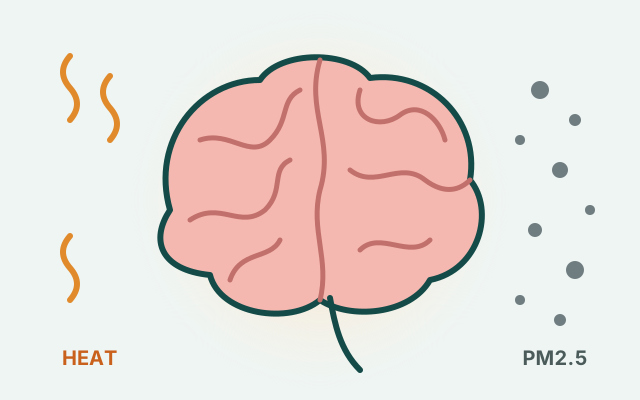
The brain is highly sensitive to its environment. Heat, polluted air, and the stress of disasters can affect how we think, sleep and feel, and can worsen many neurological conditions.
How does climate change and how does it affect us?
Over the past couple of years there has been huge amounts of research done on the connection between air pollution and brain health, air pollution as well as brain health have been proven to have direct correlation through certain air particles. Exposure to particular matter such as PM2.5 can lead to hundreds of risks that range from cognitive declines to certain neurological diseases. This highlights the importance of keeping pollution and greenhouse gas emissions low as PM 2.5 stems from such causes.
Due to larger and more devastating climate events happening year by year environmental risks as well as pollution has a higher chance of impacting our brain health. While this may seem obvious we must work together as a functioning society to go against greenhouse emissions and factors that lead to pollutants as these are the roots of the wildfires and other catastrophic events.
When it comes to protecting yourself right now the most important ways are to keep windows shut when there is a bad AQI scale that could be dangerous, it is also best to stay inside whenever there is a poor AQI scale as poor air quality is a deriving factor of negative cognitive effects from climate change.
The stress response
When we perceive a threat, the brain’s alarm system (including the amygdala and the hypothalamic–pituitary–adrenal axis) releases stress hormones such as cortisol. This is helpful in short bursts.
Repeated or prolonged stress, from disasters, ongoing climate worry, or heat itself, can keep this system switched on. Over time, chronic stress is associated with poorer sleep, memory and mood, and with inflammation in the body and brain.
Good news: the brain is adaptable. Social connection, restful sleep, physical activity, time in green spaces and a sense of purpose all help regulate the stress response and support brain health.
Protecting brain health
- Keep cool during heat waves: hydrate, seek shade or cool spaces, and cool your bedroom at night where possible.
- Check air quality alerts; reduce outdoor exertion and use filtration on smoky days.
- If you or someone you care for has a neurological condition, ask a clinician about a personal heat plan and medication risks.
- Protect sleep: a cooler, darker room and consistent routines.
- Support policies for cleaner air and cooler, greener neighbourhoods.
Sources & further reading
- Sisodiya, S. M., et al. (2024). Climate change and disorders of the nervous system. The Lancet Neurology.
- World Health Organization. Air pollution and health. who.int
- The Lancet Countdown on Health and Climate Change. lancetcountdown.org